

GreenPT Sustainability
Sustainability overview
Building a more sustainable future through measured energy and efficient AI infrastructure.
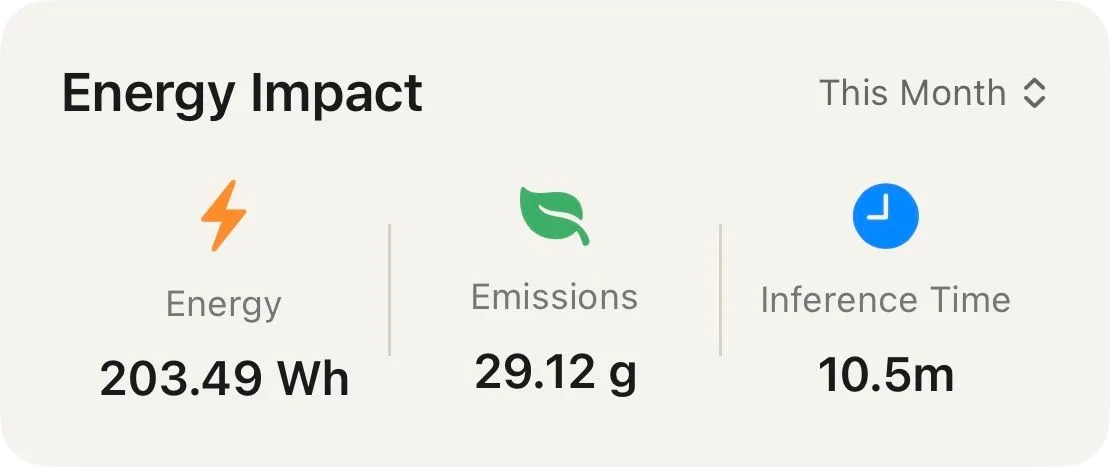
Every request's energy is measured directly from GPU hardware, not estimated. Every carbon number uses the live carbon intensity of the grid running your workload. No annual averages. No projections. We report the physical carbon intensity of the grid our servers actually run on, so you can see the energy use and associated carbon emissions of your requests.
No offsets. No greenwashing. Here's how.
-
Measured, not claimed.
Every request's energy is measured directly from GPU hardware, not estimated. Every carbon number uses the live carbon intensity of the grid running your workload. No annual averages. No projections.
-
The right model for the job
Not every question needs a heavyweight model. We match each task to the most efficient model that can handle it.
-
Leaner models, same results
Through compression and quantization, we make the AI models themselves smaller and more efficient, so every interaction costs less energy from the start.
-
Real numbers, not certificates.
We report the physical carbon intensity of the grid our servers actually run on, so you can see the energy use and associated carbon emissions of your requests.


Measured, not claimed
Honest about the grid
GreenPT is Dutch, and Europe was the natural place to start. The principles behind it were never meant to stop at a border.
The honest reality for North American infrastructure: not every grid is clean. Some regions run largely on hydro or nuclear. Others still burn a lot of fossil fuel. We won't paper over that with certificates. We measure what your request actually consumed, where it actually ran, and we show you the number, per prompt.
Model Efficiency
Model Efficiency & Future Vision
Our commitment to efficient AI and sustainable innovation.
Optimized Model Selection
We deliberately use smaller, more efficient models to reduce computational requirements without sacrificing capability.
-
Computational Efficiency
Using lower-parameter models reduces computational requirements for the tasks they can handle well.
-
Specialized Agents
Specialized lightweight agents for specific tasks minimize resource usage.
-
Prompt Optimization
Efficient prompts reduce unnecessary token usage.
Sustainability FAQ
How does your infrastructure reduce environmental impact?
- Measured infrastructure. Energy and carbon measured on every request.
- Efficient model selection. The right model for the job.
- Technical optimisations. Smaller, efficient models.
How can you measure energy per request?
Modern GPUs report their power consumption in real time. For every request, we record the GPU's energy counters when processing starts, track power throughout, and calculate the actual energy consumed. We then apply the current carbon intensity of the grid where that GPU is located, using live data from grid operators. That gives a real per-request carbon number, not a projection or an average. Most AI providers don't do this. If you bill per token, hardware-level measurement isn't in your interest. We think users deserve to know what their AI actually costs.
How do you calculate carbon emissions on the US site?
We use the carbon intensity of the grid serving your request. This varies by location and time, so the carbon figure can differ between requests. We show energy and carbon separately to help you understand both.

Free for 14 days
No claims. Just the numbers.
Start measuring your AI's energy use and CO₂ in real time, per request.
Cancel any time.
- CCPA-ready
- No training on your data
- Energy measured per request